On Facebook, identity, and control

,or, The Central Problem of Library 2.0: Identity

I am a little late on this topic, but feel it is important to add my 2 cents. Fred and Terrell have already laid the groundwork for what I am going to say by focusing the conversation away from privacy to identity. While much of this repeats what they have already said, I believe my point is a little different. This post will first examine what could have been done differently and then look at the underlying causes of this issue. Lastly, I will examine what this experience teaches us about how we should implement Library 2.0 services.

It has been interesting to see students’ reactions to the “new” Facebook. It appears to me that Facebook’s biggest mistake was rolling it out as an automatic opt-in feature. Chances are that if they quietly added it in the background, it would have spread virally without a peep.

For example, lets say Facebook added a little link somewhere on the page that says, “Want to make it easier for your friends to stay updated on what you are doing, try the new Facebook feeds?” A few students would notice this and think, “Cool now I can use this new feature that no one else knows about.” When one of their friends visited their page next, they would see the feeds complete with the notification that their friend had begun using the feeds. In this way most students would have first been introduced to the service by invading their friend’s privacy and not their friends invading theirs.

The final ingredient for a successful implementation strategy would have been to give students control over what aspects of their Facebook lives they want to share through the feeds. By turning all the feeds on automatically, students were shocked to see something they thought was private broadcast to their networks. For example, many students might be glad to share new groups they joined or friends they have made, but some students might not want all of their comments immediately apparent. To summarize:

  1. Bait early-adopters. There were students waiting for this to happen who would have chosen to turn the feature on immediately and then pressured their friends to do so.
  2. Let students choose to turn the service on based off their experiences with the profiles of early-adopters.
  3. Let students choose what aspects of their life they want to highlight and which they would rather slide under the radar.

This brings us back to the title of this post. When it comes to our identities, we like having control over how we present ourselves to the world. That is one of the reasons that social networking sites are so useful to college students. It is a way to mold your identity so that you can determine who your friends are to be. Social networking profiles and interactions present us as we wish to be seen. Given this, students were using Facebook to present different versions of themselves to different friends. When this illusion was broken, they in effect lost control of their identities. I would thus argue that the underlying concern of most students is not a loss of their privacy, but a loss of their identity. Students don’t mind sharing their personal information with the world, but want to have control over when and how it is shared.

However, if this experience gets students to think more about how they present themselves in their virtual communities, it is a good thing. So far, this experience seems to have done more to drill home the reality of online life than either university instruction or the press.


So what does this mean for Library 2.0?

First, we might want to change Rory Litwin’s primary problem of Library 2.0 from privacy to identity. This might be a better way to explain these principles to a group of students who are accustomed to sharing their data. Privacy is how we think of these issues, but is it how our users think of them?

Second, we can use this as a guiding principle when developing Library 2.0 systems. What people are researching and reading for pleasure presents a remarkable amount about their identity. We need to design systems that allow users to have control over how they present their identity. If a user wants to appear as though they read Joyce and not Grisham, then we need to allow them this choice. We also need to create ways that users can mask their identities or create multiple identities. For example, this blog is a central part of my professional identity and my MySpace account is a central part of my (online) social identity. While I have chosen to attach my real name to both, it is comforting to know that I could have chosen to present one or the other anonymously.

Third, it shows that we have a long way to go in integrating content creation skills into our information literacy programs. However, we now have an excellent example to use when discussing responsible content creation. In my previous response to Rory’s privacy post, I highlighted three information literacy skills that I felt we needed to teach as a result of an increasingly read/write world. Given this movement in understanding from privacy to identity, the three skills we need to teach would now be:

  1. Identity
  2. Ownership
  3. Security

To gain a further understanding of why I feel these are the three primary principles, I encourage you to read my original response to Rory.

Technorati tags: facebook identity privacy socialnetworking web20 library20

Cool post relating to information literacy

If you haven’t checked out Matthew Williams blog yet, here is a blurb from his most recent post:

However, in the information age where these facts are always at our fingertips, the need for memorization is far less important. The more important questions are “can you find the information?” and “can you analyze this information?”

Plagiarism is not the fault of the internet, it is the fault of poorly written essay prompts. Most times, these essay prompts are poorly written because they misunderstand or do not recognize this shift in emphasis from content mastery to higher order thinking skills (i.e., it isn’t what you know, but what you can do with what you know).

There are a few things in his essay I might argue with, but much of it is spot on. This excerpt highlights much of what I think information literacy is about these days.

Academic Library 2.0 Concept Models (Basic v2 and Detailed)

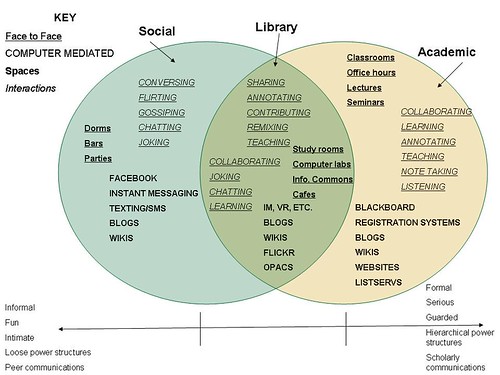
I have updated the original Academic Library 2.0 Concept Model. The new version aims to maintain the simplicity of the original, while adding a few examples and using more precise language. Also worth noting is that the line separating the physical and virtual environments is now dotted to signify the artificial nature of this boundary.

This model presents a view of how students might view the library as place in relation to their academic and social lives. It is at this intersection that I propose Library 2.0 has begun to materialize. The primary goal of the model is to encourage brainstorming over how we can develop virtual environments that will fit into students’ lives. However, I would argue that new collaborative spaces in the physical environment could also be viewed as part of L2 in so much as they are responses to changing learning styles that are partially brought on by the social nature of Web 2.0 tools. In this way, a definition of L2 that focuses on Web 2.0 might include some innovative services in the physical environment. This said, it is my belief that L2 is primarily useful as a concept for developing new online tools. To learn more about this model, you can check out the post accompanying the first model here. The comments and links at the bottom of that page will help guide one through the discussions of the original model.

Academic Library 2.0 Concept Model Basic v2

Academic Library 2.0 Concept Model Basic v2

I have also created a more detailed version of the model. In this version the boundary between physical and virtual has vanished. Furthermore, this model includes interaction types as well as places. Instead of focusing on exact tasks such as shaking hands (physical) or commenting (virtual), I have looked at interactions in a broader way. At this point, the key is a little confusing on the model, so please use the revised key posted below the model. However, the basic goal is to get people thinking about designing virtual and physical places according to the types of social interactions our patrons will be having in those environments. You will also notice that ALL of the interactions mentioned occur in both the physical and virtual places. Of course we will be seeing more places inhabiting both physical and virtual as well. For example, virtual group study rooms might supplement our physical study rooms.

The scale at the bottom of the model highlights some of the key spectra that lie between a student’s social and academic lives. Again, it is my argument that the library inhabits a space somewhere in the middle ground between these extremes.

Academic Library 2.0 Concept Model Detailed

Academic Library 2.0 Concept Model Detailed

(REVISED KEY:
underlined = physical
uppercase = virtual
interactions or spaces can be both
———————————-
non-italics = spaces
italics = interactions)

I am still working on these models and final drafts will be included in the second part of my Master’s Paper. I am also developing a model to describe Library 2.0 in general. I should have the paper done relatively soon and will post a link to it. Furthermore, the structure of the paper should work well for filling in the wiki that I proposed here.

As always, I encourage feedback. You are welcome to leave comments here or on your own blog. If you are linking to the image on Flickr, please link to this post as well, so that your contribution to the discussion will be included on this page. Thanks.

Technorati tags: library 2.0 library-20 library2.0 L2 web 2.0 web2.0 academic libraries academiclibrary20

Notes from BarCampRdu,Part 1: General, Session 1

Yesterday I attended BarCampRDU at the Red Hat campus in Raleigh. Fred Stutzman did a wonderful job of organizing, so everything went smoothly. I am going to take some time over the next few days to look over my notes and blog some of the ideas that I thought of during the discussions. Overall I had a great time and look forward to participating in many more unconferences in the future. It was an excellent way for the local tech community to get together. Now that I understand how unconferences work, I would like to take a more active role in either planning or in leading a talk next time round.

You can see Flickr photos tagged BarCampRDU here and blog posts tagged with the technorati tag here.

The first talk I went to was “Refactoring Your Wetware”:

Andy Hunt of The Pragmatic Programmers likes to talk about how your brain works. Pole-bridging, pragmatic learning, the Dreyfus model of skill acquisition, and even a little of Getting Things Done are all fair game.

While this session turned out to be more of a talk than a discussion, it was still very interesting. Andy began by setting forth the following ideas:

Using more of your brain’s horsepower!
• (experts rely on intuition) context dependent > context free (novices follow rules)
• Mastering knowledge doesn’t increase your professional effectiveness
• Problem for certification programs
• So? ->> tweak the brain
• Brain compared with computer model.
• Fast non-linear part, slow linear part but only one can access memory at any time
• 10% analytical, verbal — Geeky
• 90% irrational non-verbal – Artsy

He then went over a number of ways to get take advantage of that 90%. I feel it was a good start to the day as it got people thinking about how to look at things from different angles. Below are the notes I took. They are relatively raw. I think they are all in my own words, but a few phrases may accidently match Andy’s slides. If you get a chance to see this talk of his I would suggest going.

Thus design matters. (iPod example)
• Check out the video of Microsoft iPod – loses the design and good sense
• Drawing on the right side of the brain
• Trace an upside down image, but don’t label in your mind focus on the lines
• Default to symbol instead of reflecting on the deeper meaning

How to engage r-mode processing
• Focus on sensory experience
• Use building blocks like legos during design sessions
• Emphasize cross sensory feedback
• Lozanov Séance — yoga inspired breathing and repetition in dark room with baroque music and foreign words being repeated
• “Write drunk, but revise sober”
• Start with multi-sensory learning and then follow with traditional learning
• Memory stores every input
• Right mode actually scans these memories, but it is hard to transfer the harvested memory to the left mode because it is like trying to verbalize a dream

Image streaming
1. Ask yourself a question / pose a problem
2. Close your eyes for 10 minutes
3. For each image that crosses your mind
1. Describe it outloud
2. Imaging it using all five senses
3. Source of image not as important as interpreting it – rub eyes, look at bright light first

Journaling
• Write three mages a day in longhand, uncensored, never skip a day
• Typing is very L-mode being at the keyboard is a bad place for creativity
• BOOK – A Whack on the Side of the Head.
• Seeing something from a completely different point of view causes the right mode search algorithm to kick in differently.
• Avoid mental locks – Made me think of a book I read called The Eureka Effect that discussed very similar ideas.

Magic of the “oracle”
• is to focus pattern matching by broadening scope
• This made me think of Socrates (because he was motivated by the Oracle at Delphi). Maybe he was using his right brain?

Need to keep track of great ideas or your brain gets lazy and stops worrying about it.
• Capturing good ideas. Andy uses a space pen w/ notepad, index cards
• PDA with a wiki or sticky notes, voice recorder on pda,
• My new idea talk to Bluetooth earpiece while walking home and have the call recorded to my blog.
• Pocketmod.com
• Transcribe and integrate I a hyperlinked space (wikispace)

Context switching is bad and ruins productivity
• Multitasking and interruption like checking email (-10iq) worse than smoking a joint (-4iq)
• Second monitor yields productivity gains of 20%-30%

That was the end of my notes. I will post more notes and ideas later over the next few days.

Technorati tag: barcamprdu

Social networking site usage: An explanation for Facebook

Social Networking Traffic Chart Fred Wilson created this chart to display the traffic of some of the major social networking sites. Fred Stutzman has posted an argument as to why the Facebook numbers might be misleading. While I am not sure I agree fully with Fred’s explanation, I agree with him that Facebook has a winning model.

The chart shows increase in users. MySpace has shown a dramatic increase in users. However, its general nature makes it hard to determine whether users will be loyal, or if they will turn to the next big thing. On the other hand, Facebook has one primary audience, college students, and a number of secondary audiences, everyone else. As Fred’s research and theories demonstrate, Facebook is an extremely valuable tool for college students. His data shows that in both 2005 and 2006, virtually 100% of UNC-Chapel Hill freshman chose to participate in the Facebook. Furthermore, there is plenty of reason to believe that this is not unique to UNC. This would mean that the Facebook has already maxed out on new users in their primary target market. While this might impede growth at the rate MySpace has shown, this is excellent as it means that Facebook cycles through new primary user groups every four years. Furthermore, given their complete market dominance over college students, it would be very difficult for a competitor to take take their primary business away.

The one place that I feel Facebook is vulnerable to competition is on the Academic side of their services. If course management software either integrated better with how students study and work, or integrated better with other datasets and resources on campus, then students would come to rely on them more. I will be discussing this idea further in my Master’s paper.

technorati tags: facebook myspace social networking