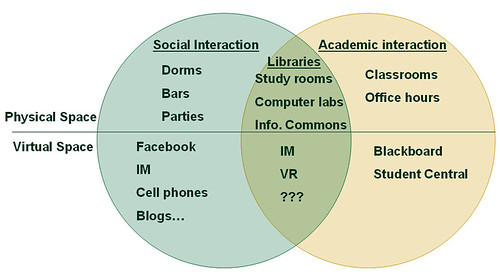
Online learning communities thesis concept map by Jeremy Hiebert

Jeremy Hiebert has developed a concept map for his Master’s thesis on online learning communities. I am going to check out the site he used to create it.

I am thinking it might be helpful to develop a similar concept map for my Master’s paper. I am currently working on an updated version of my Academic Library 2.0 Concept Model. It might be useful to develop a concept map for the larger project of defining Academic Library 2.0.

I encourage any new readers to go back and read my original post on the model and to read my more recent post about the Academic Library 2.0 wiki project I am working on.

Academic library 2.0 concept model

The Library’s Role in the Creative Economy

Best Buy’Â’s Anderson understands that harnessing the full power of the Creativity Economy means more that implementing new technology and designing captivating new products. He likes to say that the great promise of the creative era is that, for the first time in our history, the further development of our economic competitiveness hinges on the fuller development of human creative capabilities. In other words, our economic success increasingly turns on harnessing the creative talents of each and every human being, regardless of sex, age, race, ethnicity, or sexual orientation.

The above quote is taken from “The Future of the American Workforce in the Global Creative Economy” by Richard Florida (From the June 4th issue of Cato Unbound via Arts & Letters Daily).

The article discusses how the greatest job growth is in the creative and service sectors. The creative sector includes such fields as science and technology, design and entertainment, and knowledge work; while the service sector includes such fields as customer service, retail, and food services. Unfortunately, the creative sector is much better paid. The excerpt above describes one of the solutions to this problem that feels right to me. All employees should be given the opportunity to apply creative solutions to their work.

I also think that libraries of all sorts can play a key role as the workforce continues its transition. It has always been the goal to serve all users no matter what their job. While many workers in creative fields have received excellent educations and have ample intellectual resources available, service workers are often left wanting for resources. It is important that libraries strive to make materials available that will assist service workers in their creative endeavors. As more of these materials become available on the web, librarians also need to train users in how to discover the appropriate resources for themselves.

Thoughts on Library Juice library 2.0 and privacy post

I have not yet been able to read all of the comments for “The Central Problem of Library 2.0: Privacy” by Rory Litwin, but would like to share my current views on this very important issue. I have previously blogged about my recent use of social networking software and blogs, but I haven’t yet touched on the idea of privacy. Like community, I became very interested in privacy issues while working at the Northborough Free Library. While there, I dumped all of their interlibrary loan records, helped rewrite their computer use policy to reflect the recent passing of the USA PATRIOT Act, and changed the settings on the public access computers to eliminate patron browsing records. When I came to graduate school I did not exist on the web and was proud of it.

I am still very concerned about patron privacy and I remain slightly paranoid about my web presence. However, given my profession, it is important to have a web presence. Furthermore, I want one. I am tired of being paranoid about what potential employers may think when reading my blog or googling me. This doesn’t mean that I don’t expect them to google me. In fact I encourage it. However, I do my best to maintain a professional presence and to control the amount and type of information that is available about me. ClaimID was created with this function in mind and is the type of tool that everyone will need in the future.

As Rory mentioned, many millennials (which by some definitions I am, though I think of myself as GenX), lack the concerns for privacy needed to responsibly manage their personal information. However, while Rory chalks this up to immaturity, I would argue that it is more a lack of proper education. While we would all like private corporations to take responsibility for educating their users in responsible use of their services, this is not realistic. It is for this reason that information literacy training is fast becoming one of the most important services provided by a library. Under the Library 1.0 model, library patrons were consumers of information resources, now they are also contributors. Consequently, I have come to believe that we, as librarians, need to educate our users to be responsible contributors to Web 2.0 and Library 2.0 services. So then what does one need to know to be a responsible contributor?

There are three issues that I think librarians need to educate their users on.

1. Privacy
2. Ownership
3. Security

The first two Rory touched on, but I would like to add a little. We need to teach our users that it is their responsibility to control their personal information. Library 2.0 involves “radical trust” of our users. This radical trust means a significant loss of control. As much as we would like to protect them, we can’t always. With our Library 2.0 services, we need to be clear about what information patrons will be sharing and give them control. We also need to educate them on how to use commercial services. As Rory mentioned, this gets into the second issue, ownership.

We need to educate our users about copyright. The read/write web makes everyone an author. Thus far, the education system has failed to teach people about intellectual property. Librarians are all about providing information for free. Not many other people are. Information is a very valuable commodity and librarians have to remember this when educating their patrons.

We need to have excellent security measures in place. I am more afraid about my credit card company getting hacked for my data than I am about the information I choose to share about myself. It is important that we build secure systems so that we can keep our patrons information safe.

All this being said, I often worry about whether what I am about to post will cost me a job someday. Yesterday, my mom and stepfather both commented that I looked kind of scraggly in the picture I had in my sidebar and that I should chose a different picture if potential employers might be reading my blog. The picture is down now. It is still all over the web however. I have tried to separate my professional and personal online lives the best I can. I don’t try to hide my personal life, but I try to make sure that potential employers will recognize the differences between my serious LinkedIn/ClaimID side and my social Myspace/Friendster side. That is the type of distinction we need to get our users thinking about.

library 2.0web 2.0 academiclibrary20

Communty Workshop Series

I have been teaching a few classes a month on such topics as internet basics and computer basics at the local public libraries as part of the Community Workshop Series, which is a collaborative venture between the University Librarie’s and the local public libraries. Since we started this program last fall I have designed two courses based off my past experience working as a reference technician at the Northborough Free Library in Central Massachusetts. This morning there were 11 attendees to my “Creating a Resume in Microsoft Word” Workshop, which is the best turnout I have yet had for this one. Hopefully things continue to grow. A few weeks ago we got some press and at least one person from the class I taught a few weeks ago had found out from the paper. Hopefully things continue to pick up.

Visit by Audio Activism’s Brian Russell

Yesterday, Brian Russell (audioactivism.org) spoke to my blogging seminar about podcasting. His talk discussed a number of topics including the use of podcasting for activism, not journalism. I, however, was most interested in his discussion of media literacy which describes the ability to understand the the structure and presentation of content in mass media. This is clearly a very important skill for an informed public in an age with so many different types of media. I certainly see this as highly related to information literacy. While librarians train patrons to evaluate information on the web and in print media, it seems that the evaluation of audio/visual forms of mass media, such as TV, are often left out of information literacy curricula designed for college and adult students. I am not sure if school media specialist’s are trained to teach these skills to students. One important aspect of media literacy seems to be empowering individuals to understand how mass media communications are created and designed to influence viewers. I think all too often librarians, myself included, focus too much on how users can evaluate the end product and don’t go into enough detail on how websites or journals are actually created. Stepping back and examining the structure of something can often add a deeper level of understanding. For example, learning algebra adds an additional layer of meaning to simple arithmetic. Brian will be podcasting the entire discussion soon and I will add a link then.