Available now is the video of my plenary talk at the 11th International Conference on Scientific Digitalization of Cultural and Scientific Heritage, University Repositories and Distance Learning. My slides and notes are available here.
Tag: journals
Raising visibility of local data collections through linking with international publication databases (Belgrade, Serbia)

UPDATE – The video of the presentation is now available.
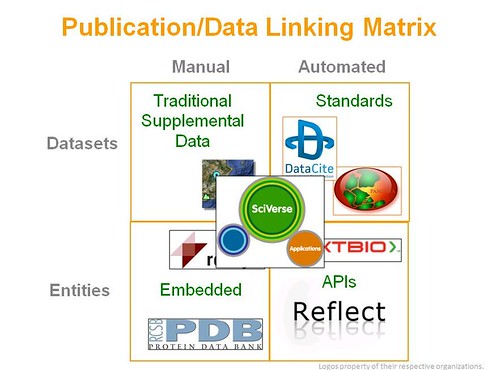
This past weekend, I had the opportunity to visit Belgrade as a speaker at the 11th International Conference on Scientific Digitalization of Cultural and Scientific Heritage, University Repositories and Distance Learning. It was an excellent conference with even better hosts. My presentation discussed different ways that finished publications can be connected with related data. The below matrix summarizes the different options and the examples covered in the presentation:
The full presentation is below along with my notes:
View more documents from Michael Habib
Abstract: Connecting locally hosted data repositories to internationally hosted related articles has never been easier. With APIs and other web services becoming standardized at the same time that new linking standards, such as Datacite DOIs, are being adopted, new ways to distribute and mashup content are now possible. This presentation will explore emerging trends in linking scholarly literature to data. Both entity linking and data linking will be discussed. Examples will be presented demonstrating how these technologies are being employed by publishers and A&I vendors in cooperation with local data repositories.
links for 2010-01-28
-
From article about SNIP – “Across a subject field as broad as scholarly communication, assessing journal impact by citations to a journal in a two-year time frame is obviously going to favor those subjects that cite heavily, and rapidly. Some fields, particularly those in the life sciences, tend to conform to this citation pattern better than others, leading to some widely recognized distortions.”
-
From article: “Prestige measured by quantity of citations is one thing, but when it is based on the quality of those citations, you get a better sense of the real value of research to a community. Research Trends talks to Prof. Félix de Moya about SCImago Journal Rank (SJR), which ranks journals based on where their citations originate.”
-
From article :Bibliometric indicators are not without their own controversies (1, 2) and recently there has been an explosion of new metrics, accompanying a shift in the mindset of the scientific community towards a multidimensional view of journal evaluation.”
links for 2010-01-26
-
Elsevier’s Scopus Partners with CWTS and SCImago to Offer Multidimensional Evaluation of Research JournalsFrom press release: “Elsevier… announced that its flagship product Scopus has successfully partnered with the Centre for Science and Technology Studies (CWTS) and the SCImago Research Group, endorsing two complementary journal metrics, SNIP and SJR. The metrics will be freely available online at www.journalmetrics.com, and integrated into Scopus, allowing researchers around the world to analyze journals within the abstract and citation database. The indicators will offer a greater currency and flexibility in journal performance measurement than any single-metric method currently available.”
-
Download SNIP and SJR values for Scopus journals.
-
SJR & SNIP versus IMPACT FACTOR“How do SJR and SNIP compare to the Impact Factor? They offer new perspectives in Journal Evaluation that look at the context in which a journal is performing and normalize for citation behaviour. Find more information at www.journalmetrics.com”
-
Introduction SJR & SNIP powered by ScopusVideo
-
Calculation of SNIP & SJR powered by Scopus (video)“This short video explains how SCImago Journal Rank (SJR) and Source Normalized Impact per Paper (SNIP) are calculated. SJR and SNIP are considering in which context in which a Journal is performing looking at differences in research areas with different citation behaviours. “
-
Looks like an interesting introductory course to the various concepts of scientific publishing and Science 2.0. (found because it linked to my Identity 2.0 post)