Academic Library 2.0 Concept Models (Basic v2 and Detailed)

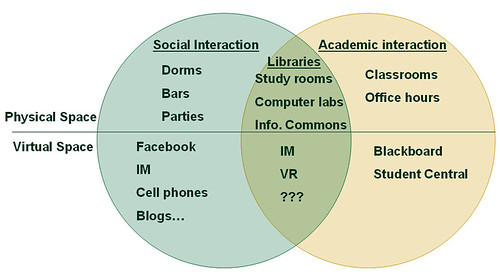
I have updated the original Academic Library 2.0 Concept Model. The new version aims to maintain the simplicity of the original, while adding a few examples and using more precise language. Also worth noting is that the line separating the physical and virtual environments is now dotted to signify the artificial nature of this boundary.

This model presents a view of how students might view the library as place in relation to their academic and social lives. It is at this intersection that I propose Library 2.0 has begun to materialize. The primary goal of the model is to encourage brainstorming over how we can develop virtual environments that will fit into students’ lives. However, I would argue that new collaborative spaces in the physical environment could also be viewed as part of L2 in so much as they are responses to changing learning styles that are partially brought on by the social nature of Web 2.0 tools. In this way, a definition of L2 that focuses on Web 2.0 might include some innovative services in the physical environment. This said, it is my belief that L2 is primarily useful as a concept for developing new online tools. To learn more about this model, you can check out the post accompanying the first model here. The comments and links at the bottom of that page will help guide one through the discussions of the original model.

Academic Library 2.0 Concept Model Basic v2

Academic Library 2.0 Concept Model Basic v2

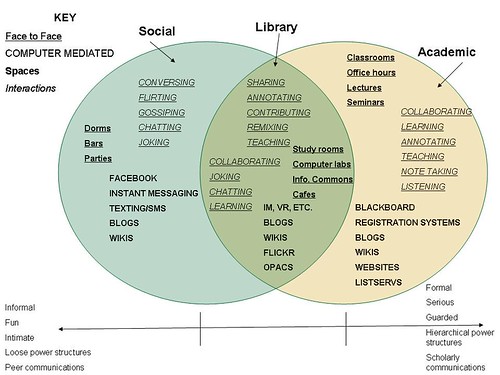
I have also created a more detailed version of the model. In this version the boundary between physical and virtual has vanished. Furthermore, this model includes interaction types as well as places. Instead of focusing on exact tasks such as shaking hands (physical) or commenting (virtual), I have looked at interactions in a broader way. At this point, the key is a little confusing on the model, so please use the revised key posted below the model. However, the basic goal is to get people thinking about designing virtual and physical places according to the types of social interactions our patrons will be having in those environments. You will also notice that ALL of the interactions mentioned occur in both the physical and virtual places. Of course we will be seeing more places inhabiting both physical and virtual as well. For example, virtual group study rooms might supplement our physical study rooms.

The scale at the bottom of the model highlights some of the key spectra that lie between a student’s social and academic lives. Again, it is my argument that the library inhabits a space somewhere in the middle ground between these extremes.
Academic Library 2.0 Concept Model Detailed

Academic Library 2.0 Concept Model Detailed

(REVISED KEY:
underlined = physical
uppercase = virtual
interactions or spaces can be both
———————————-
non-italics = spaces
italics = interactions)

I am still working on these models and final drafts will be included in the second part of my Master’s Paper. I am also developing a model to describe Library 2.0 in general. I should have the paper done relatively soon and will post a link to it. Furthermore, the structure of the paper should work well for filling in the wiki that I proposed here.

As always, I encourage feedback. You are welcome to leave comments here or on your own blog. If you are linking to the image on Flickr, please link to this post as well, so that your contribution to the discussion will be included on this page. Thanks.

Technorati tags: library 2.0 library-20 library2.0 L2 web 2.0 web2.0 academic libraries academiclibrary20
Academic Library 2.0 Wiki/Blog and Master’s paper

As I work on my Master’s paper over the next 2-3 weeks my posts will be less frequent. My Master’s paper will focus on my Academic L2 concept model. Once I get that wrapped up, I promise to add significant amounts of original content.

I am going to revise the model significantly. As I am finishing up with the paper, I plan to post the updated model to solicit feedback from the L2 community. It is my hope that I will be able to link to the discussion as an appendix to my paper. Of course, the conversation will continue once the paper is finished.

I am still figuring out how to integrate these conversations into my paper/project. I am tossing the idea around of setting up a wiki or blog devoted to Academic Library 2.0 and posting the model and my paper to get the discussion started. Would anyone be interested in such a project? If so let me know and I will see if I can work on setting up the site as part of my project.

I know a few bloggers have been posting about Academic Library 2.0. Would anyone be interested in contributing to a community project? What other resources might be useful instead of a blogs and wikis? Squidoo? Let me know your ideas.

I know there is already a Library 2.0 wiki. Would it be better if I started adding articles to that one? Is there some other format that would be easier for people. I am thinking a communal blog might be better for fostering discussion. Given the nature of the model, I am focusing on getting academic librarians more actively involved in the L2 discussion.

If you like this idea, please help me publicize it. Thank you for your support.

library 2.0 academiclibrary20

Responses to Academic L2 Concept Model

Again, thanks to Michael Stephens for pointing my model out to the readers of Tame The Web. Since his post, my model has been viewed over 300 times. Over 100 readers continued on to my blog to view the post. So far I have found three other blog entries about it. I would like to share my responses to each of these four posts. I will address them in the order the were discovered.

1. Tame the Web: Michael liked “the blend of technology, space and people!” I wish I could have stated it so succinctly. It is about where people live and work and how they interact in those spaces.

2. Rick L. Fought at The Bailey Blog posted about the model asking his readers, “What do you think of his blending of the library and technology?” What I like best is that this appears to be the blog for librarians at the Bailey Library, Hendrix College. This demonstrates that they are atarting to build these spaces for their librarians. I notice they have a wiki as well.

3. Peta at Innovate noticed the ??? and posed the central question the model was meant to get people thinking about: “Ok, what else goes below the line in the green Libraries area?” This is exactly the kind of brainstorming I hoped to facilitate. How can this model get us thinking about what new services we should provide? To see some of her answers, you can view her post here.

4. Jennifer of Life as I Know It argues that many Academic libraries identify solely with the academic side of the spectrum. When I made the model, I was trying to explore the virtual side of things. I am now thinking it might also be a helpful tool for explaining new services in the physical library. She states:

I think many academic libraries identify solely with the academic part of the college experience – and this might account for some of the hesitation in adopting social software. Often if something doesn’t support the academic mission of the college, it gets vetoed. However, it would be difficult to argue that libraries are not social spaces – just social spaces in which academic endeavors take place.

Technorati tags: library 2.0 academiclibrary20

Welcome visitors and more on Library 2.0 and online community

My sitemeter tells me that people have started checking out my site over the last view days. If I am reading the data correctly, I have to thank Steven M. Cohen at Library Stuff for finding my blog and adding it to a post titled Tons of New to Me Library Blogs. A few people were also driven here by the bookmark on Library Things del.icio.us account. A few folks came in through searches for items tagged “Library 2.0”. No matter how you got here, thank you for checking out my blog and I encourage you to subscribe to my feed.

I was hoping my tags in flickr, del.icio.us, etc. would bring people to check out my Academic Library 2.0 Concept Model. At my first job out of university, I worked as a Reference Technician at the Northborough Free Library. It was there that I got a full sense of how libraries foster community. I was impressed with how the library brought people together through both formal (book discussion groups, teen programs, etc.) and informal (public access computers, the daily newspaper, etc.) means. Since then, one of my main goals has been to devise ways to translate this sense of community into the online environment.

While digital collections seemed to be developing rapidly, the accompanying digital communities seemed to be lagging behind. Though my current model only addresses academic libraries, I am currently developing parallel models for public libraries and cultural institutions in general. It is my hope that these models will demonstrate the importance of Library 2.0 and at the same time inspire new and creative services. As the term Library 2.0 implies, looking to how Web 2.0 companies have succeeded in encouraging community and harnessing collectively intelligence is certainly one of the first steps librarians must take to accomplish this goal.

library 2.0web 2.0 academiclibrary20

Conceptual model for Academic Library 2.0

Academic library 2.0 concept model

I developed the above model for a paper I wrote for INLS 342: Academic Libraries Seminar. This is very much a work in progress. I hope to explore this area further for my Master’s Paper.

The paper was titled Defining Academic Library 2.0. However, in it I argue for a narrower definition of Library 2.0 than the broader definitions proposed by Michael Casey and Michael Stephens. My narrower definition is as follows:

The application and adaptation of the Web 2.0 model to the library environment (both virtual and physical).

Consequently, the above model proposes a way to look at the libraries role in students lives in a Web 2.0 world.

Below is a slightly edited excerpt from my paper:

One approach to adapting Web 2.0 technologies to academic library services is to examine how these technologies already fit into student life and then determine the library’s role in this picture. Figure 2 introduces one conceptual framework that applies this method. This model analyzes the libraries’ position as a physical place in student life and then draws parallels with libraries’ possible position as a virtual place. The model is based on the concept that most of student life is divided between the social and the academic and that physical libraries have traditionally provided a unique location that mixes the two. A more precise model would show a spectrum between social and academic places with libraries falling near the middle. At one end is the strictly academic formal classroom. Here the professor is an authority to the student. At the opposite end is a party, a purely social occasion. Libraries have traditionally provided a place where students could collaborate on school work without the pressure of being watched by an authority figure, thus allowing them to socialize while they work. Of course, this space also provided students with whatever research materials and reference assistance they might need. Towards this end, librarians have traditionally tried to maintain strict patron confidentiality so as to keep the library a safe haven from authority. Furthermore, many academic libraries now provide popular materials collections to provide residential students with materials for pleasure reading, thus further blending the line between social and academic space. Recent trends in academic libraries have moved closer to blending this line by adding coffee shops, WiFi access and Information Commons. If one accepts that the physical library provides students with this blended environment, then one might ask, “How might the library provide a similar virtual space?” To find an answer to this question, this conceptual model creates a parallel spectrum describing a student’s virtual life. At the academic end of the spectrum, lies course management software such as Blackboard. Similar to the classroom, this space is controlled by the professor and has the same authority structure. On the social end of the spectrum, is Facebook. Students traditionally think of this as a safe social place devoid of authority figures. This is demonstrated by the fact that students have recently been punished for information they post to Facebook. To examine this phenomenon, one need only Google “facebook” and “discipline”. Stutzman’s research demonstrates this feeling of safety (2005; 2006). Given this spectrum, what virtual place might the library provide for students? One possibility would be virtual group study rooms. Such a place might provide the tools to enable students to collaborate remotely and asynchronously on course projects. This space might also provide resources and links to live reference help to assist students in their work. This place would be different from Blackboard because professors would not be able to review students’ discussions. This proposal is just one possibility; hopefully this conceptual framework suggests others. This conceptual framework only suggests one way to examine how academic libraries might apply Web 2.0 concepts to their mission. Another way is to examine what data academic libraries have available.

To learn more about my vision for Academic Library 2.0, you can view a copy of the accompanying presentation here (.pdf)

library 2.0web 2.0 academiclibrary20