I have updated the original Academic Library 2.0 Concept Model. The new version aims to maintain the simplicity of the original, while adding a few examples and using more precise language. Also worth noting is that the line separating the physical and virtual environments is now dotted to signify the artificial nature of this boundary.
This model presents a view of how students might view the library as place in relation to their academic and social lives. It is at this intersection that I propose Library 2.0 has begun to materialize. The primary goal of the model is to encourage brainstorming over how we can develop virtual environments that will fit into students’ lives. However, I would argue that new collaborative spaces in the physical environment could also be viewed as part of L2 in so much as they are responses to changing learning styles that are partially brought on by the social nature of Web 2.0 tools. In this way, a definition of L2 that focuses on Web 2.0 might include some innovative services in the physical environment. This said, it is my belief that L2 is primarily useful as a concept for developing new online tools. To learn more about this model, you can check out the post accompanying the first model here. The comments and links at the bottom of that page will help guide one through the discussions of the original model.

I have also created a more detailed version of the model. In this version the boundary between physical and virtual has vanished. Furthermore, this model includes interaction types as well as places. Instead of focusing on exact tasks such as shaking hands (physical) or commenting (virtual), I have looked at interactions in a broader way. At this point, the key is a little confusing on the model, so please use the revised key posted below the model. However, the basic goal is to get people thinking about designing virtual and physical places according to the types of social interactions our patrons will be having in those environments. You will also notice that ALL of the interactions mentioned occur in both the physical and virtual places. Of course we will be seeing more places inhabiting both physical and virtual as well. For example, virtual group study rooms might supplement our physical study rooms.
The scale at the bottom of the model highlights some of the key spectra that lie between a student’s social and academic lives. Again, it is my argument that the library inhabits a space somewhere in the middle ground between these extremes.
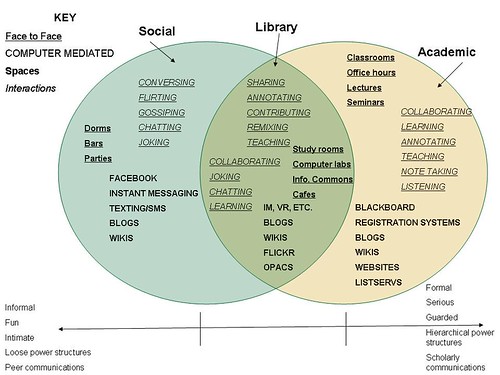
underlined = physical
uppercase = virtual
interactions or spaces can be both
———————————-
non-italics = spaces
italics = interactions)
I am still working on these models and final drafts will be included in the second part of my Master’s Paper. I am also developing a model to describe Library 2.0 in general. I should have the paper done relatively soon and will post a link to it. Furthermore, the structure of the paper should work well for filling in the wiki that I proposed here.
As always, I encourage feedback. You are welcome to leave comments here or on your own blog. If you are linking to the image on Flickr, please link to this post as well, so that your contribution to the discussion will be included on this page. Thanks.
Technorati tags: library 2.0 library-20 library2.0 L2 web 2.0 web2.0 academic libraries academiclibrary20