Academic Library 2.0 Concept Models (Basic v2 and Detailed)

I have updated the original Academic Library 2.0 Concept Model. The new version aims to maintain the simplicity of the original, while adding a few examples and using more precise language. Also worth noting is that the line separating the physical and virtual environments is now dotted to signify the artificial nature of this boundary.

This model presents a view of how students might view the library as place in relation to their academic and social lives. It is at this intersection that I propose Library 2.0 has begun to materialize. The primary goal of the model is to encourage brainstorming over how we can develop virtual environments that will fit into students’ lives. However, I would argue that new collaborative spaces in the physical environment could also be viewed as part of L2 in so much as they are responses to changing learning styles that are partially brought on by the social nature of Web 2.0 tools. In this way, a definition of L2 that focuses on Web 2.0 might include some innovative services in the physical environment. This said, it is my belief that L2 is primarily useful as a concept for developing new online tools. To learn more about this model, you can check out the post accompanying the first model here. The comments and links at the bottom of that page will help guide one through the discussions of the original model.

Academic Library 2.0 Concept Model Basic v2

Academic Library 2.0 Concept Model Basic v2

I have also created a more detailed version of the model. In this version the boundary between physical and virtual has vanished. Furthermore, this model includes interaction types as well as places. Instead of focusing on exact tasks such as shaking hands (physical) or commenting (virtual), I have looked at interactions in a broader way. At this point, the key is a little confusing on the model, so please use the revised key posted below the model. However, the basic goal is to get people thinking about designing virtual and physical places according to the types of social interactions our patrons will be having in those environments. You will also notice that ALL of the interactions mentioned occur in both the physical and virtual places. Of course we will be seeing more places inhabiting both physical and virtual as well. For example, virtual group study rooms might supplement our physical study rooms.

The scale at the bottom of the model highlights some of the key spectra that lie between a student’s social and academic lives. Again, it is my argument that the library inhabits a space somewhere in the middle ground between these extremes.
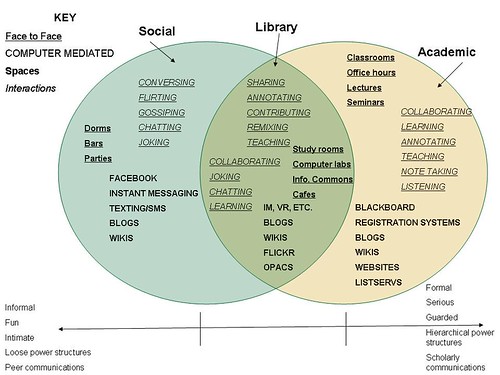
Academic Library 2.0 Concept Model Detailed

Academic Library 2.0 Concept Model Detailed

(REVISED KEY:
underlined = physical
uppercase = virtual
interactions or spaces can be both
———————————-
non-italics = spaces
italics = interactions)

I am still working on these models and final drafts will be included in the second part of my Master’s Paper. I am also developing a model to describe Library 2.0 in general. I should have the paper done relatively soon and will post a link to it. Furthermore, the structure of the paper should work well for filling in the wiki that I proposed here.

As always, I encourage feedback. You are welcome to leave comments here or on your own blog. If you are linking to the image on Flickr, please link to this post as well, so that your contribution to the discussion will be included on this page. Thanks.

Technorati tags: library 2.0 library-20 library2.0 L2 web 2.0 web2.0 academic libraries academiclibrary20

On libraries and social bookmarking sites

Amanda at blogwithoutalibrary.net has posted about libraries using del.icio.us. I have been thinking about this a lot recently and am now going to share some of the random thoughts I have been having.

I am surprised more libraries aren’t integrating social bookmarking into their websites. I wonder how many have opened accounts to their patrons? How many allow patron tagging? Do any libraries offer classes in how to use social bookmarking applications? Is there anyway libraries could get their patrons working together to rank and order bookmarks related to local interests? Maybe a library could work with local newspapers to develop such a system. Maybe a library could work with local schools to help students collaborate on research projects using social bookmarking applications. I wonder if any teachers or school librarians have experimented with anything like this.

It is cool that San Matteo uses Dewey, but isn’t that making a simple concept overly complicated? Dewey was designed for classification of physical objects where each item could only be located in one spot. Tagging allows digital objects to exist in many places at once.

I need to look more closely at what libraries are already doing with social bookmarking sites. I also need to look more closely at what libraries are doing with Flickr and social photosharing sites. I will share more ideas on this later.

Some responses to the Web 2.0 section of OCLC’s NextSpace


This is a multipart section, so I will only be responding to individual ideas that struck me.

1. Rick Anderson was the first commentator. In his piece he argues:

But if our services can’t be used without training, then it’s the services that need to be fixed — not our patrons. One-button commands, such as Flickr’s “Blog This”, and easy-to-use programs like Google Page Creator, offer promising models for this kind of user-centric service.

While I whole-heartedly agree that our web services need to be functionally intuitive, in its entirety this section of Rick’s argument seems to bash user education. As I have argued before, I think that education is even more important in a Web 2.0 world. I believe we need to teach users to think critically about how to evaluate and contribute to Web 2.0 conversations and resources. I do agree with Anderson that libraries are ill-equipped to educate all of our users in the classroom. I see this as a call to build new online resources and services that help our patrons learn the skills needed to survive in a Web 2.0 information landscape.

2. In the second section, Michael Stephens’s discusses core attributes of Librarian 2.0. In contrast to Anderson, he states:

Users will create their own mash ups, remixes and original expressions and should be able to do so at the library or via the library’s resources. This librarian will help users become their own programming director for all of the content available to them.

If not through education, how will librarians guide their patrons in this process of discovery and creation?

3. In the third section Chip Nilges discusses how OCLC is building off the principles of Web 2.0. He states the following:

O’Reilly’s notion of  harnessing collective intelligence, for instance, is at the heart of OCLC’s cataloging cooperative, resource sharing network, and virtual reference cooperative.

He later explains,

Services under consideration include including tagging, list creation and sharing, citation management, personal cataloging, and the like.

I see the move from the first of these stages to the second as the true transition to Web 2.0. It shows a move to recognizing library patrons as the true end users of our services and collections. Furthermore, it represents a more explicit trust in the collective intelligence of our users.

4. I love some of the practical suggestions posed by John Riemer. I will highlight my favorites, but will refrain from discussing them in great detail because I am already exploring them in my Master’s paper. A couple of ideas are the following:

Relevance ranking techniques should be driven by much more than the mere prevalence of keywords in the bibliographic record and be fed by a wider range of metadata, such as circulation activity, placement of materials on class reserve lists, sales data, and clicks to download, print, and capture citations.

User-initiated services like renewal, recalls, and interlibrary loan requests should be complemented by views into the campus bookstore’s inventory, options to purchase from an online bookseller, displays of availability in any geographically proximate library, opportunities to see and select terms for expedited delivery, etc.

If you want to learn more about how I envision the above services, or why they fall into core Web 2.0 values, please check back to read my Master’s paper.

5. The final commentator, Dr. Wendy Shultz is a futurist. In her section, she attempts to describe both current and distant trends. In fact she makes it all the way through Library 4.0. I am going to wait a little before I start worrying this far into the future.

Academic Library 2.0 Wiki/Blog and Master’s paper

As I work on my Master’s paper over the next 2-3 weeks my posts will be less frequent. My Master’s paper will focus on my Academic L2 concept model. Once I get that wrapped up, I promise to add significant amounts of original content.

I am going to revise the model significantly. As I am finishing up with the paper, I plan to post the updated model to solicit feedback from the L2 community. It is my hope that I will be able to link to the discussion as an appendix to my paper. Of course, the conversation will continue once the paper is finished.

I am still figuring out how to integrate these conversations into my paper/project. I am tossing the idea around of setting up a wiki or blog devoted to Academic Library 2.0 and posting the model and my paper to get the discussion started. Would anyone be interested in such a project? If so let me know and I will see if I can work on setting up the site as part of my project.

I know a few bloggers have been posting about Academic Library 2.0. Would anyone be interested in contributing to a community project? What other resources might be useful instead of a blogs and wikis? Squidoo? Let me know your ideas.

I know there is already a Library 2.0 wiki. Would it be better if I started adding articles to that one? Is there some other format that would be easier for people. I am thinking a communal blog might be better for fostering discussion. Given the nature of the model, I am focusing on getting academic librarians more actively involved in the L2 discussion.

If you like this idea, please help me publicize it. Thank you for your support.

library 2.0 academiclibrary20

Responses to Academic L2 Concept Model

Again, thanks to Michael Stephens for pointing my model out to the readers of Tame The Web. Since his post, my model has been viewed over 300 times. Over 100 readers continued on to my blog to view the post. So far I have found three other blog entries about it. I would like to share my responses to each of these four posts. I will address them in the order the were discovered.

1. Tame the Web: Michael liked “the blend of technology, space and people!” I wish I could have stated it so succinctly. It is about where people live and work and how they interact in those spaces.

2. Rick L. Fought at The Bailey Blog posted about the model asking his readers, “What do you think of his blending of the library and technology?” What I like best is that this appears to be the blog for librarians at the Bailey Library, Hendrix College. This demonstrates that they are atarting to build these spaces for their librarians. I notice they have a wiki as well.

3. Peta at Innovate noticed the ??? and posed the central question the model was meant to get people thinking about: “Ok, what else goes below the line in the green Libraries area?” This is exactly the kind of brainstorming I hoped to facilitate. How can this model get us thinking about what new services we should provide? To see some of her answers, you can view her post here.

4. Jennifer of Life as I Know It argues that many Academic libraries identify solely with the academic side of the spectrum. When I made the model, I was trying to explore the virtual side of things. I am now thinking it might also be a helpful tool for explaining new services in the physical library. She states:

I think many academic libraries identify solely with the academic part of the college experience – and this might account for some of the hesitation in adopting social software. Often if something doesn’t support the academic mission of the college, it gets vetoed. However, it would be difficult to argue that libraries are not social spaces – just social spaces in which academic endeavors take place.

Technorati tags: library 2.0 academiclibrary20