Scopus March 2012 release overview: New Document Details Pages, Interoperability with Hub, Lipid Structures (beta), etc.

These slides and accompanying description outline the rationale and process for recently released updates to Scopus including Sciverse Hub integration and 2 new SciVerse Applications.

The below slides outline the updates to Scopus released last weekend. While most of these changes have already been announced on the SciVerse blog, this goes into a bit more detail on why the updates were made. It also mentions some of the smaller updates not yet announced and introduces some of what I feel to be the most interesting new SciVerse Applications for Scopus.

For two of the more interesting projects, I would like to go into more detail on the process and rationale behind the changes. One of the most noticeable changes is that the interface of the  main panel of the Document Details (Abstract) page has been completely overhauled.  The primary goal for this revamp was to improve the scanability and readability of the page.

We started with the user research already done for the Article of the Future and the new article page on ScienceDirect. From that foundation, our User-Centered Design group developed a prototype and conducted usability studies with researchers and librarians to determine which design elements transferred to  Scopus. As part of this research, we gathered information on which parts of the page users scan for first. The implemented design then focused on optimizing the visual hierarchy, so that the most used information is more prominent. Fonts were also optimized throughout to make reading of abstracts and other elements easier.

The other most noticeable change is the replacement of the tabs from the Document search results pages. When enabled, these tabs would run a users search on Web and Patent content from Scirus. The new links instead display the results in SciVerse Hub. While all existing functionality remains, Hub offers a lot of advantages to the tab structure. Most importantly, Hub offers improved relevancy rankings and additional refine options.  Hub also collapses multiple copies of the same document into a single record.

As part of this update, we now only display the links if results are available and display the results count in the link. Some readers may remember that this count used to be in the tabs, but was removed. Usage has since proven that display of this count is extremely important for users. The More tab has been replaced by a link to “Secondary documents” that works exactly the same as the tab. Our User-Centered Design group also developed a prototype and conducted usability studies to optimize these changes.

Hopefully the the above slides and description, help to give a full picture as to how the recent updates help improve the Scopus user experience.  Please feel free to leave feedback on these changes in the comments.

Raising visibility of local data collections through linking with international publication databases (Belgrade, Serbia)

11th International Conference on Scientific Digitalization of Cultural and Scientific Heritage, University Repositories and Distance Learning

UPDATE – The video of the presentation is now available.

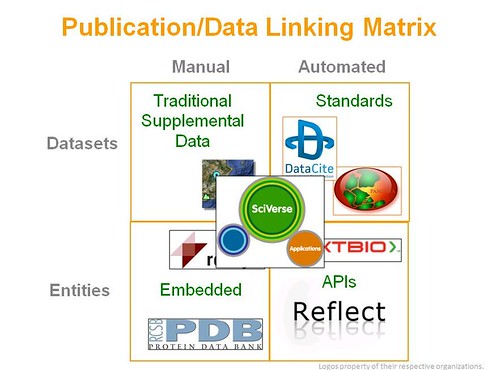
This past weekend, I had the opportunity to visit Belgrade as a speaker at the 11th International Conference on Scientific Digitalization of Cultural and Scientific Heritage, University Repositories and Distance Learning.  It was an excellent conference with even better hosts.  My presentation discussed different ways that finished publications can be connected with related data.  The below matrix summarizes the different options and the examples covered in the presentation:

Publication/Data Linking Matrix

The full presentation is below along with my notes:

View more documents from Michael Habib
Abstract:  Connecting locally hosted data repositories to internationally hosted related articles has never been easier.  With APIs and other web services becoming standardized at the same time that new linking standards, such as Datacite DOIs, are being adopted, new ways to distribute and mashup content are now possible.  This presentation will explore emerging trends in linking scholarly literature to data.  Both entity linking and data linking will be discussed.  Examples will be presented demonstrating how these technologies are being employed by publishers and A&I vendors in cooperation with local data repositories.

Weekly Activity for 2010-11-28

weekly activity digest

# habib: RT @jaykaydee: My dissertation: “Beliefs and Uses of Tagging Among Undergraduates” http://bit.ly/97bJQI If you’re into that sort of thing

# habib: RT @mfenner: New blog post: ORCID session at #solo10 and other important #orcid news http://bit.ly/crZzWg

# habib: RT @gthorisson: My latest SlideShare upload: ORCID presentation from Science Online London 2010 – http://slidesha.re/dqjO0F

# habib: RT @ORCID_Org: We’re officially a non-profit! Announced today, ORCID initiative is now ORCID, Inc http://bit.ly/c8L8hW

# RT @IanMulvany: #solo10 some pics and links to presentations from the session I hosted. http://directedgraph.net/2010/09/07/solo10-presentation-slides/

# WEBINAR (free): The Future of Search and Discovery, Sept. 8 w/ Jud Dunham and Cameron Neylon http://t.co/tiia9JS

# RT @Machemes: New and Unique Tool Eases the Process of Finding Article Reviewers: The search is based on the Scopus macheme fo… http://bit.ly/9U3bEy

# My slides from Connecting Scientific Resources at Science Online London 2010 available at http://t.co/3vrgEc1 #solo10 #li @IanMulvany @rjw