On Facebook, identity, and control

,or, The Central Problem of Library 2.0: Identity

I am a little late on this topic, but feel it is important to add my 2 cents. Fred and Terrell have already laid the groundwork for what I am going to say by focusing the conversation away from privacy to identity. While much of this repeats what they have already said, I believe my point is a little different. This post will first examine what could have been done differently and then look at the underlying causes of this issue. Lastly, I will examine what this experience teaches us about how we should implement Library 2.0 services.

It has been interesting to see students’ reactions to the “new” Facebook. It appears to me that Facebook’s biggest mistake was rolling it out as an automatic opt-in feature. Chances are that if they quietly added it in the background, it would have spread virally without a peep.

For example, lets say Facebook added a little link somewhere on the page that says, “Want to make it easier for your friends to stay updated on what you are doing, try the new Facebook feeds?” A few students would notice this and think, “Cool now I can use this new feature that no one else knows about.” When one of their friends visited their page next, they would see the feeds complete with the notification that their friend had begun using the feeds. In this way most students would have first been introduced to the service by invading their friend’s privacy and not their friends invading theirs.

The final ingredient for a successful implementation strategy would have been to give students control over what aspects of their Facebook lives they want to share through the feeds. By turning all the feeds on automatically, students were shocked to see something they thought was private broadcast to their networks. For example, many students might be glad to share new groups they joined or friends they have made, but some students might not want all of their comments immediately apparent. To summarize:

  1. Bait early-adopters. There were students waiting for this to happen who would have chosen to turn the feature on immediately and then pressured their friends to do so.
  2. Let students choose to turn the service on based off their experiences with the profiles of early-adopters.
  3. Let students choose what aspects of their life they want to highlight and which they would rather slide under the radar.

This brings us back to the title of this post. When it comes to our identities, we like having control over how we present ourselves to the world. That is one of the reasons that social networking sites are so useful to college students. It is a way to mold your identity so that you can determine who your friends are to be. Social networking profiles and interactions present us as we wish to be seen. Given this, students were using Facebook to present different versions of themselves to different friends. When this illusion was broken, they in effect lost control of their identities. I would thus argue that the underlying concern of most students is not a loss of their privacy, but a loss of their identity. Students don’t mind sharing their personal information with the world, but want to have control over when and how it is shared.

However, if this experience gets students to think more about how they present themselves in their virtual communities, it is a good thing. So far, this experience seems to have done more to drill home the reality of online life than either university instruction or the press.


So what does this mean for Library 2.0?

First, we might want to change Rory Litwin’s primary problem of Library 2.0 from privacy to identity. This might be a better way to explain these principles to a group of students who are accustomed to sharing their data. Privacy is how we think of these issues, but is it how our users think of them?

Second, we can use this as a guiding principle when developing Library 2.0 systems. What people are researching and reading for pleasure presents a remarkable amount about their identity. We need to design systems that allow users to have control over how they present their identity. If a user wants to appear as though they read Joyce and not Grisham, then we need to allow them this choice. We also need to create ways that users can mask their identities or create multiple identities. For example, this blog is a central part of my professional identity and my MySpace account is a central part of my (online) social identity. While I have chosen to attach my real name to both, it is comforting to know that I could have chosen to present one or the other anonymously.

Third, it shows that we have a long way to go in integrating content creation skills into our information literacy programs. However, we now have an excellent example to use when discussing responsible content creation. In my previous response to Rory’s privacy post, I highlighted three information literacy skills that I felt we needed to teach as a result of an increasingly read/write world. Given this movement in understanding from privacy to identity, the three skills we need to teach would now be:

  1. Identity
  2. Ownership
  3. Security

To gain a further understanding of why I feel these are the three primary principles, I encourage you to read my original response to Rory.

Technorati tags: facebook identity privacy socialnetworking web20 library20

Cool post relating to information literacy

If you haven’t checked out Matthew Williams blog yet, here is a blurb from his most recent post:

However, in the information age where these facts are always at our fingertips, the need for memorization is far less important. The more important questions are “can you find the information?” and “can you analyze this information?”

Plagiarism is not the fault of the internet, it is the fault of poorly written essay prompts. Most times, these essay prompts are poorly written because they misunderstand or do not recognize this shift in emphasis from content mastery to higher order thinking skills (i.e., it isn’t what you know, but what you can do with what you know).

There are a few things in his essay I might argue with, but much of it is spot on. This excerpt highlights much of what I think information literacy is about these days.

Obligatory blog day post complete with related ramblings

Apparently it is blog day. For this exercise, I have chosen to share six blogs that I think my readers might find interesting. Given that the majority of my readers are librarians, the first few are more tech oriented blogs that might be off their radar.

  • Unit Structures by Fred Stutzman — Regular readers might recognize this site as I have pointed to his posts numerous times. Fred, a PhD student here at UNC and a co-founder of claimid.com, focuses his research on identity and social networking. He has done some fascinating research on Facebook usage at UNC and has developed some valuable theories (Situational Relavance, The Network Effect Multiplier, etc.) concerning social networking. Anyone interested in how social software fits into the university life should check out Fred’s writings. One recent post of interest that I don’t believe I have yet pointed out is Orientation 2.0.
  • FactoryCity by Chris Messina — Chris is an “Independent Open Source Ambassador at Large and co-founder of Citizen Agency.” I met Chris at BarCampRDU where I attended his sesson on social browsing. He is heavily involved in all things open. He is currently devoting a lot of time to microformats (highly relevant to libraries), BarCamps, which he helped start (the precursor to Library Camps), and a number of other projects. While his writings aren’t directly related to what we do, Chris is a prolific and experienced blogger who is working on some cool stuff.

They are both also involved in OpenID, which is something librarians should be looking at as it would provide our users with a single logon. We should be pressuring both our vendors and universities to look into this. To find out more about OpenID, check out the summary I wrote of Fred’s social software session and Chris’s social browsing session here.

The next few blogs I wish to share are related to educational technology:

  • I only found I am Matthew Williams and You are Not last week, but it is already one of my favorite blogs. He is a writing instructor at the University of Minnesota who writes on a range of topics including collaborative learning and social software. His posts are frequent, long, insightful, and, not surprisingly, exceptionally well written. This blog truly is a gem and I highly reccommend checking it out.
  • heyjude: Making fortunate discoveries – Web 2.0, Library 2.0, and more ¦ by Judy O’Connell – Judy is an experienced teacher, school librarian. I have found her blog to offer a great deal of practical advice into how to teach others about Web 2.0, Library 2.0, social software and more. She also offers a great deal of practical ways to use software for teaching. I often find that her writing helps me stay grounded and to see things from new perspectives. Pretty much everything she writes is related to the topics of my blog so I am not going to point out any specific posts. I encourage you to go explore.

Okay now for two library blogs:

  • Life as I Know It by Jennifer Macaulay – Jennifer is both a student at Southern Connecticut State and a systems librarian. I have found her writings about her classwork to be quite valuable. She also points out lots of valuable biblioblogosphere stuff that I might otherwise miss. I also found out about blog day from her.
  • The Library Rebooted: Unwrapped – Blog about Technologies Visited in MLC™s 2006/2007 Special Program Series: The Library Rebooted – This blog just went live a few days ago, and will feature contributions from participants, presenters, and other L2 voices. I am very excited to announce that I myself will be contributing some posts to the blog (thanks Evette!). The program and the blog both have a lot of potential and I look forward to watching them develop.

Academic Library 2.0 Concept Models (Basic v2 and Detailed)

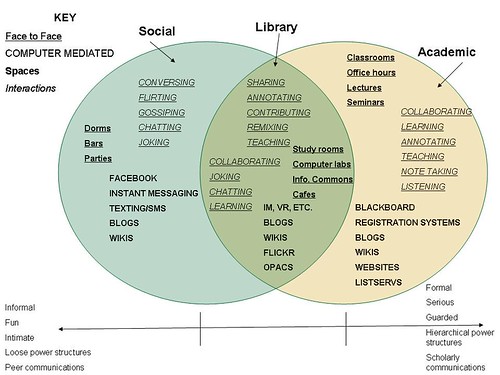
I have updated the original Academic Library 2.0 Concept Model. The new version aims to maintain the simplicity of the original, while adding a few examples and using more precise language. Also worth noting is that the line separating the physical and virtual environments is now dotted to signify the artificial nature of this boundary.

This model presents a view of how students might view the library as place in relation to their academic and social lives. It is at this intersection that I propose Library 2.0 has begun to materialize. The primary goal of the model is to encourage brainstorming over how we can develop virtual environments that will fit into students’ lives. However, I would argue that new collaborative spaces in the physical environment could also be viewed as part of L2 in so much as they are responses to changing learning styles that are partially brought on by the social nature of Web 2.0 tools. In this way, a definition of L2 that focuses on Web 2.0 might include some innovative services in the physical environment. This said, it is my belief that L2 is primarily useful as a concept for developing new online tools. To learn more about this model, you can check out the post accompanying the first model here. The comments and links at the bottom of that page will help guide one through the discussions of the original model.

Academic Library 2.0 Concept Model Basic v2

Academic Library 2.0 Concept Model Basic v2

I have also created a more detailed version of the model. In this version the boundary between physical and virtual has vanished. Furthermore, this model includes interaction types as well as places. Instead of focusing on exact tasks such as shaking hands (physical) or commenting (virtual), I have looked at interactions in a broader way. At this point, the key is a little confusing on the model, so please use the revised key posted below the model. However, the basic goal is to get people thinking about designing virtual and physical places according to the types of social interactions our patrons will be having in those environments. You will also notice that ALL of the interactions mentioned occur in both the physical and virtual places. Of course we will be seeing more places inhabiting both physical and virtual as well. For example, virtual group study rooms might supplement our physical study rooms.

The scale at the bottom of the model highlights some of the key spectra that lie between a student’s social and academic lives. Again, it is my argument that the library inhabits a space somewhere in the middle ground between these extremes.

Academic Library 2.0 Concept Model Detailed

Academic Library 2.0 Concept Model Detailed

(REVISED KEY:
underlined = physical
uppercase = virtual
interactions or spaces can be both
———————————-
non-italics = spaces
italics = interactions)

I am still working on these models and final drafts will be included in the second part of my Master’s Paper. I am also developing a model to describe Library 2.0 in general. I should have the paper done relatively soon and will post a link to it. Furthermore, the structure of the paper should work well for filling in the wiki that I proposed here.

As always, I encourage feedback. You are welcome to leave comments here or on your own blog. If you are linking to the image on Flickr, please link to this post as well, so that your contribution to the discussion will be included on this page. Thanks.

Technorati tags: library 2.0 library-20 library2.0 L2 web 2.0 web2.0 academic libraries academiclibrary20

“Librarian of Basra” puppet show

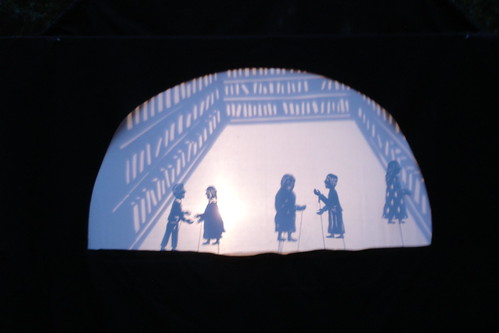
Patrons at the Library of Basra

Yesterday I was fortunate to attend the Paperhand Puppet Intervention’sAs the Crow Flies: Tales From Four Directions“. Danielle Latman, took a number of photos that I have now uploaded to my Flickr account.

The fourth and last part of the show was a puppet rendition of Jeannette Winter’s book “The Librarian of Basra“. For obvious reasons, we took particular care to document that part. Above is the first image from the series. If you click here and follow the photo stream, the photos and their titles will share (part of) the story of Alia Muhammad Baker, the librarian of Basra. (If you play the slideshow, the captions will be lost.)

“The Librarian of Basra” tells the true story of how Alia, a librarian in Basra, took steps to protect the books in her library both leading up to and during the War in Iraq.

While not related to libraries, the third part, “Seeing with New Eyes”, was also very impressive and featured a 20ft+ Buddha. Below is a picture of the giant Buddha in a battle of wills with a giant demon, Mara.

Buddha is surrounded by Mara and his Demons

You can view all of the photos from the puppet show here.

If you are in the Triangle region, the show runs through the weekend of Sept. 8-9. You can find details about showtimes here.

Technorati tags: Iraq Basra puppets Paperhand librarian librarians