-
Richard Ackerman on Web 2.0 and science.
-
Presenation for the Editors’ Conference this upcoming Saturday.
Tag: scholarly communication
Engaging a New Generation of Authors, Editors, and Reviewers – Presentation for Boston Editors’ Conference
This is the second presentation I will be giving to editors since having taken on the role of Product Manager for 2collab. The presentation breaks down into three sections.
First, I present the findings from the Social Media web survey conducted in May 2008 by my predecessors at 2collab. Conducted using Survey Monkey, 40,000 randomly sampled registered users of ScienceDirect were contacted with a 4.6% response rate yeilding 1,824 responses.
This survey demonstrated that early career researchers (25-44 yrs/old, 1-10 articles), are not only using social media heavily, but they are using it more for work than for play. When comparing how this demographic is currently using social media for work, with how the entirety of respondents expect social media to be used in the next two years, one can see gaps in what tools are available and what are desired. A lot of what I am working on as a Collaboration Tools Product Manager will try to fill these and other gaps in a researcher’s workflow.
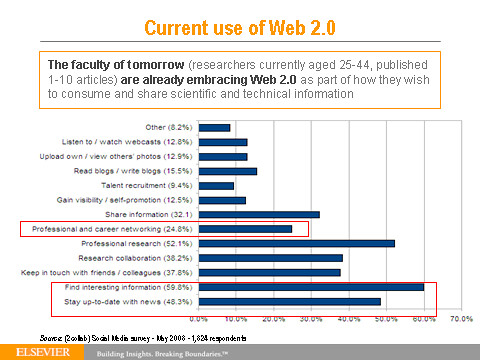
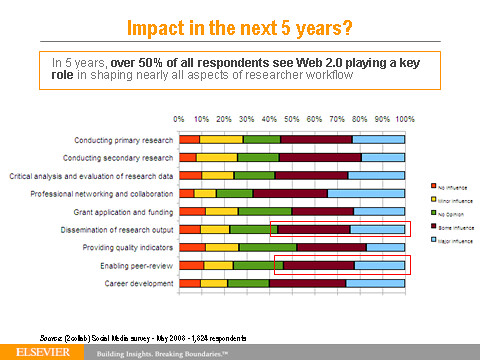
After showing how early career researchers are currently using social media, I delve into 2collab as an example of one possible tool journal editors can use to engage with this demographic. One of my primary suggestions is suggesting that authors use 2collab to share their articles alongside supplementary content related to their articles. For example, one can use 2collab to share images from a paper, related presentations, and the article itself all in one place. One of the reasons I was motivated to write this post was to practice what I preach. Some screenshots of Flickr, Slideshare, my blog, and 2collab, related to this post are still to be included in the appendix of the presentation as an example.
Last, I open things up for discussion. To do this I prompt editor’s to think about how they can apply available Web 2.0 tools to the tasks of editing, such as promotion of articles. For those of you familiar with my Master’s paper, you will recognize this methodology as 1 part of my Academic 2.0 theory.
When you get a chance, please take a look at the presentation and let me know if you have any suggestions about how journal editor’s or authors can use social media.
Also, please send any examples you know of editors using social media such as blogs or Flickr to interact with authors, editorial boards, or readers. Thanks.
links for 2008-01-24
-
We’re Not Dead Yet! – 11/15/2004 – Library Journal
“University presses can survive and thrive if university libraries work with them to create a sustainable future for scholarly communication” by Barbara Fister and Niko Pfund — Library Journal, 11/15/2004
-
AAUP & ARL: 2004 The Year of the University Press
“The Development of an Open Source Publishing System by Terry Ehling, Director of Electronic Publishing at Cornell University Library. Prior to her Cornell appointment, she was Manager of the Digital Projects Lab at the MIT Press. “
-
“The adoption of open-source publishing systems like DPubS can correct the imbalance in the scholarly communication environment by providing a venue for nontraditional publishing initiatives.”
-
“University presses are at the cutting edge of electronic publishing, often working in collaboration with each other, with their university libraries, and with scholarly societies. Below are links to some of the e-Publishing initiatives currently under wa