Yesterday, Brian Russell (audioactivism.org) spoke to my blogging seminar about podcasting. His talk discussed a number of topics including the use of podcasting for activism, not journalism. I, however, was most interested in his discussion of media literacy which describes the ability to understand the the structure and presentation of content in mass media. This is clearly a very important skill for an informed public in an age with so many different types of media. I certainly see this as highly related to information literacy. While librarians train patrons to evaluate information on the web and in print media, it seems that the evaluation of audio/visual forms of mass media, such as TV, are often left out of information literacy curricula designed for college and adult students. I am not sure if school media specialist’s are trained to teach these skills to students. One important aspect of media literacy seems to be empowering individuals to understand how mass media communications are created and designed to influence viewers. I think all too often librarians, myself included, focus too much on how users can evaluate the end product and don’t go into enough detail on how websites or journals are actually created. Stepping back and examining the structure of something can often add a deeper level of understanding. For example, learning algebra adds an additional layer of meaning to simple arithmetic. Brian will be podcasting the entire discussion soon and I will add a link then.
Category: UNC
Jimmy Wales visit to my virtual communities seminar
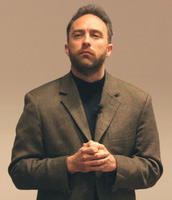
Jimmy Wales visited my class this morning. I learned a lot about the way conflict has been managed on the U.S. version of Wikipedia. One topic of discussion was how the communities of different language versions have developed different methods for mediating conflict. It makes sense, but I hadn’t thought of that. Jimmy admitted to having little direct knowledge of how some languages are managing these issues because he can’t read many of them himself. This is good news when considering the sustainability of the project once he leaves. It was very interesting to hear his thoughts on issues of control and how the Wiki model is very different in this respect from many other models for social software. I definitely need to do some more research into the theory underlying the Wiki model. One funny thing I found out about was the Guerilla UK spelling campaign. Fortunately, I just discovered that their is a counter campaign. Had I known sooner that my nation’s honor (not honour) was at stake, I might have become a more active user!
Dr. Mary Beth Oliver’s (Penn. State) visit to my psych. of HCI seminar
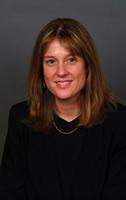
Mary Beth Oliver visited my psychology of HCI today. She spoke on individual differences in media effects research. Her research is largly focused on traditional media like tv as opposed to the internet. Consequently, much of the discussion focused on possible ways to to research the effects of individual differences on internet use.
One of the major things I got out of it is the potential to research how individual differences effect the way people interpret information. The classic example of this is a study done on the tv show All in the Family. Unfortunately, I don’t have the citation with me at the moment. But the idea is that bigoted people interpret Archie Bunker as the hero while other people see open-minded characters as the heros. The example is so great because it is relatively obvious to anyone who has seen the show that this would occur. What effects does this type of phenomenon have on interactive media?
The way people interact with news on the web is one area where one might examine how individual differences effect interaction. Last semester Kelly Garrett spoke at SILS about his dissertation research in this area. Some of the preliminary data he has collected suggests differences between how liberals and conservatives choose whether to read news articles that contradict or support their views.
“Need for cognition” is another personal differences factor that may prove very important in research on information gathering by different populations.
Next week Dr. S. Shyam Sundar, Director of the Media Effects Lab at Penn. State, will be visiting the class.
About

UPDATED: 11/22/2006
With this blog I hope to add an original and unique voice to the conversations being held by library and information services professionals. I frequently discuss Library 2.0, Web 2.0, information literacy instruction (both in academic and public libraries), virtual reference (IM, chat, etc.), distance education, social networking services, social and community informatics, intellectual freedom, and privacy.
The Author
I will be graduating from the School of Information and Library Scienceat UNC-Chapel Hill in December. I am currently seeking employment at either a library or a web services company.
I plan to develop online communities and services that promote the idea of digital library as place. Like physical libraries, digital libraries need to be community centers, collaborative study spaces, meeting spaces, etc. In addition, I plan to train library users to use new technologies and information resources.
To accomplish these goals, I have gained experience in traditional library services as well as chat and instant messaging reference services. Through my coursework, I have explored the theories and technologies necessary to develop thriving online communities.
You can view a copy of my resume here: .pdf
My Master’s Paper: Toward Academic Library 2.0
For a complete list of websites related to me please visit my ClaimID page:
You can learn more about my professional qualifications on LinkedIn:
Michael C. Habib |
Disclaimer
All opinions on this blog are those of the author and do not express the views of any of his affiliates.