On libraries and social bookmarking sites

Amanda at blogwithoutalibrary.net has posted about libraries using del.icio.us. I have been thinking about this a lot recently and am now going to share some of the random thoughts I have been having.

I am surprised more libraries aren’t integrating social bookmarking into their websites. I wonder how many have opened accounts to their patrons? How many allow patron tagging? Do any libraries offer classes in how to use social bookmarking applications? Is there anyway libraries could get their patrons working together to rank and order bookmarks related to local interests? Maybe a library could work with local newspapers to develop such a system. Maybe a library could work with local schools to help students collaborate on research projects using social bookmarking applications. I wonder if any teachers or school librarians have experimented with anything like this.

It is cool that San Matteo uses Dewey, but isn’t that making a simple concept overly complicated? Dewey was designed for classification of physical objects where each item could only be located in one spot. Tagging allows digital objects to exist in many places at once.

I need to look more closely at what libraries are already doing with social bookmarking sites. I also need to look more closely at what libraries are doing with Flickr and social photosharing sites. I will share more ideas on this later.

Social networking site usage: An explanation for Facebook

Social Networking Traffic Chart Fred Wilson created this chart to display the traffic of some of the major social networking sites. Fred Stutzman has posted an argument as to why the Facebook numbers might be misleading. While I am not sure I agree fully with Fred’s explanation, I agree with him that Facebook has a winning model.

The chart shows increase in users. MySpace has shown a dramatic increase in users. However, its general nature makes it hard to determine whether users will be loyal, or if they will turn to the next big thing. On the other hand, Facebook has one primary audience, college students, and a number of secondary audiences, everyone else. As Fred’s research and theories demonstrate, Facebook is an extremely valuable tool for college students. His data shows that in both 2005 and 2006, virtually 100% of UNC-Chapel Hill freshman chose to participate in the Facebook. Furthermore, there is plenty of reason to believe that this is not unique to UNC. This would mean that the Facebook has already maxed out on new users in their primary target market. While this might impede growth at the rate MySpace has shown, this is excellent as it means that Facebook cycles through new primary user groups every four years. Furthermore, given their complete market dominance over college students, it would be very difficult for a competitor to take take their primary business away.

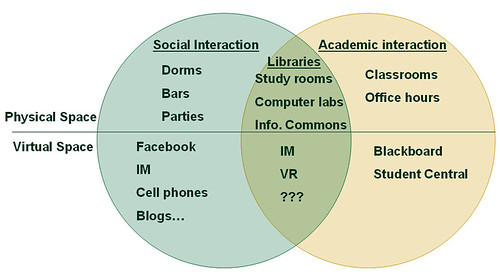
The one place that I feel Facebook is vulnerable to competition is on the Academic side of their services. If course management software either integrated better with how students study and work, or integrated better with other datasets and resources on campus, then students would come to rely on them more. I will be discussing this idea further in my Master’s paper.

technorati tags: facebook myspace social networking

Online learning communities thesis concept map by Jeremy Hiebert

Jeremy Hiebert has developed a concept map for his Master’s thesis on online learning communities. I am going to check out the site he used to create it.

I am thinking it might be helpful to develop a similar concept map for my Master’s paper. I am currently working on an updated version of my Academic Library 2.0 Concept Model. It might be useful to develop a concept map for the larger project of defining Academic Library 2.0.

I encourage any new readers to go back and read my original post on the model and to read my more recent post about the Academic Library 2.0 wiki project I am working on.

Academic library 2.0 concept model

Comments on “The Network Effect Multiplier, or, Metcalfe’s Flaw”

Yesterday Fred Stutzman posted about a social networking theory that he is developing. I am just going to address the central theory and then outline a couple of ideas that came to mind while reading.

Therefore, the fundamental flaw in applying Metcalfe to social technology is its inherent lack of nuance and granularity. When people join the network, they are given more options than simply connecting; the network is worth the sum of associations and actions that are allowed in the network. We must instead think of network value in terms of a network effect multiplier, as the actual value a network adds to an application is under the direct control of the application designers.

The above paragraph introduces Fred’s theory. Essentially, Metcalfe’s law applied wonderfully for binary networks, but fails to take into account the multifaceted nature of modern social networks. One of the examples Fred uses is MySpace. He points out that value is not limited to how many connections a user has but is also enhanced by the various types of interactions and actions enabled by the system.

Lately I have spent time in MySpace connecting with old friends. In so doing, I have come to appreciate the customization of MySpace over sites such as Friendster and Facebook. While this customization leads to much bad design, it also enables users to add third party flash widgets to their profiles. By adding third party services, a user can in effect build in value beyond what the sites designers intended. For example, the new service txtdrop.com allows users to build text messaging capability into their MySpace profiles. In fact, this ability to mashup applications and services is one of the key features of Web 2.0. If mashups continue to be the norm and social networking sites such as MySpace begin to offer open API’s , then any new participant could bring in or develop third party value beyond the control of the designers.

Fred’s piece also made me think of other types of networks such as Wikipedia. A user’s contribution to this service can be measured in intellectual contributions as well as through interactions and actions. I really don’t have any conclusions as to how Fred’s theory applies to these networks, but am interested to see how he applies or expands his theory accordingly.

I was also thinking about how different users of web networks often have different capabilities from one another according to their administrative privileges or user type. Might it be possible to apply Fred’s theory to how many or how few privileges users should receive?

Lastly, I though of the “paradox of choice“. At what point do added features or interactivity begin to detract from the value of a network by overwhelming the users? What is the proper balance between the number of users and the complexity of the service they are participating in? I wonder if these extremes are inversely proportional so that a massive network like MySpace could be clogged if it had both too many features and too many users, but a small network of experts might benefit from a highly complex feature set. Fred’s theory might be a good starting place to explore these questions.

I am now going to read over Fred’s theory a few more times to make sure my comments are on track. If not, these are still ideas inspired by his paper.

Technorati tags: web2.0 socialnetworking networks networktheory

Freshman facebook usage 2005 vs. 2006


Fred published a new Facebook study:

As my previous study included data collected in summer 2005, I thought it might be useful to compare that data against data collected this summer. This study will compare snapshots of freshman use of Facebook on the UNC-Chapel Hill campus on June 27, 2005 and June 27, 2006.

The results are just as fascinating as last year.