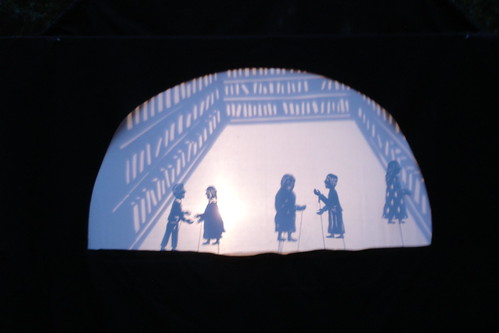
“Librarian of Basra” puppet show

Patrons at the Library of Basra

Yesterday I was fortunate to attend the Paperhand Puppet Intervention’sAs the Crow Flies: Tales From Four Directions“. Danielle Latman, took a number of photos that I have now uploaded to my Flickr account.

The fourth and last part of the show was a puppet rendition of Jeannette Winter’s book “The Librarian of Basra“. For obvious reasons, we took particular care to document that part. Above is the first image from the series. If you click here and follow the photo stream, the photos and their titles will share (part of) the story of Alia Muhammad Baker, the librarian of Basra. (If you play the slideshow, the captions will be lost.)

“The Librarian of Basra” tells the true story of how Alia, a librarian in Basra, took steps to protect the books in her library both leading up to and during the War in Iraq.

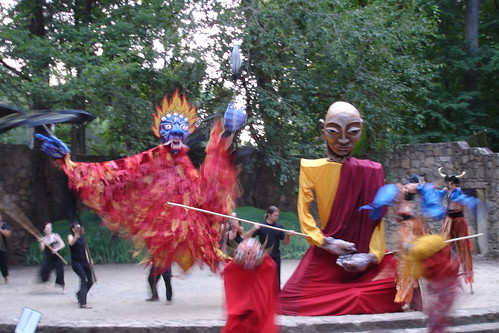
While not related to libraries, the third part, “Seeing with New Eyes”, was also very impressive and featured a 20ft+ Buddha. Below is a picture of the giant Buddha in a battle of wills with a giant demon, Mara.

Buddha is surrounded by Mara and his Demons

You can view all of the photos from the puppet show here.

If you are in the Triangle region, the show runs through the weekend of Sept. 8-9. You can find details about showtimes here.

Technorati tags: Iraq Basra puppets Paperhand librarian librarians

The Library’s Role in the Creative Economy

Best Buy’Â’s Anderson understands that harnessing the full power of the Creativity Economy means more that implementing new technology and designing captivating new products. He likes to say that the great promise of the creative era is that, for the first time in our history, the further development of our economic competitiveness hinges on the fuller development of human creative capabilities. In other words, our economic success increasingly turns on harnessing the creative talents of each and every human being, regardless of sex, age, race, ethnicity, or sexual orientation.

The above quote is taken from “The Future of the American Workforce in the Global Creative Economy” by Richard Florida (From the June 4th issue of Cato Unbound via Arts & Letters Daily).

The article discusses how the greatest job growth is in the creative and service sectors. The creative sector includes such fields as science and technology, design and entertainment, and knowledge work; while the service sector includes such fields as customer service, retail, and food services. Unfortunately, the creative sector is much better paid. The excerpt above describes one of the solutions to this problem that feels right to me. All employees should be given the opportunity to apply creative solutions to their work.

I also think that libraries of all sorts can play a key role as the workforce continues its transition. It has always been the goal to serve all users no matter what their job. While many workers in creative fields have received excellent educations and have ample intellectual resources available, service workers are often left wanting for resources. It is important that libraries strive to make materials available that will assist service workers in their creative endeavors. As more of these materials become available on the web, librarians also need to train users in how to discover the appropriate resources for themselves.

On Democracy, Trust and Libraries

One of the primary characteristics of Web 2.0 is that it involves trusting one’s users. As librarians, we have always placed immense trust in our users. As defenders of intellectual freedom we have defended freedom of speech, freedom of the press, freedom to meet, and so on. We have collected the most unpopular and crude materials alongside those that are popular and beautiful. We collect political commentary from all sides of an issue. It has always been my belief that we do this because we trust in our patrons to be curious, intelligent, and compassionate readers. Our democracy is founded on the idea that, given both sides of an argument the majority of people will be able to distinguish what is good and true from what is bad and false. We have always trusted that this majority of our readers will be able to distinguish the good from the bad. Moreover, we have trusted our patrons to use the knowledge they have gained outside of the walls of the library. Like the press, libraries expose people to all ideas and expect them to use this knowledge in political, academic, and social discourse. Towards this mission, we not only collect different points of view, but open our meeting rooms. We let all groups use our meeting rooms, but allow all patrons to attend, whether in support or protest. As librarians we are neutral. At the reference desk, we attempt to give our patrons whatever resources they need to discover the true answer to their problems. We let them decide for themselves. This is extreme trust. How then is Library 2.0 different?

Traditionally, excluding our meeting rooms, we expected our patrons to use the knowledge they gained outside of the library. Eventually ideas would trickle back in through traditional media sources such as newspapers and books. The read/write web has sped this process up. Now it is possible for readers to feed their knowledge back into the system in real-time. Libraries have always been considered places of reading. Library 2.0 is a place of both reading and writing. I would argue that it was always our idea that patrons would write their ideas down and that they would eventually reenter our libraries as part of the historical record. We always trusted that the majority of our writers strive to distinguish that which is good and true. Library 2.0 now requires us to maintain this trust in the majority. We must continue to trust that most readers are curious, intelligent and compassionate. The only difference is that the evidence of this will now be created and stored on our servers. It has always been easier to put hate group propaganda in the stacks than it has been to host hate groups in meeting rooms because the first can be obviously lost among the true and good arguments around it. In fact, it is only noticed when we search for it. In the meeting room or on our blogs, that hate speech is in your face. However, I guarantee that if any such bigotry is posted to a political discussion hosted on our blogs, it will quickly be drowned out by the voices of more responsible patrons. Moreover, those citizens will cite other sources on the web and in our collections. They might even make a compelling enough argument that the minds of a few lurkers are changed. This is what democracy is all about. This is what libraries have always been about. Web 2.0 has just changed the dynamic of how intellectual inquiry and democracy operate. In this way Library 2.0 speaks to some of the best of traditional library values, and, in so doing, defends the library as a cornerstone of democracy in a networked world.

To me Library 2.0 is not revolutionary, but instead evolutionary. As my Academic Library 2.0 Concept Model suggests, I believe the main goal of Library 2.0 is to figure out how to carryout the libraries’ traditional roles in a read/write world.

I was just about to post this and noticed that Barbara Fister has touched upon these ideas in a post titled Gathering Intelligence on the ACRLog. She proposes the following in a discussion of Wikipedia:

Wikipedia could be a useful and familiar metaphor for the collective intelligence in the library – and for the social networking that has gone on for centuries.

I also noticed Learning is essentially a social activity by Judy O’Connell:

Ultimately, it’s not just about skills and competencies in isolation, but about skills and competencies within the greater context of our global society. The reality is that the web environments of social networks are very empowering when utilised to develop ideas, share resources, hone knowledge and empower creativity.

_______________
In my next post, I am currently planning to explore how we might use the principles of Customer Relationship Management (CRM) and Web 2.0 to harness the collective wisdom of our patrons.

library 2.0 academiclibrary20

Thoughts on Library Juice library 2.0 and privacy post

I have not yet been able to read all of the comments for “The Central Problem of Library 2.0: Privacy” by Rory Litwin, but would like to share my current views on this very important issue. I have previously blogged about my recent use of social networking software and blogs, but I haven’t yet touched on the idea of privacy. Like community, I became very interested in privacy issues while working at the Northborough Free Library. While there, I dumped all of their interlibrary loan records, helped rewrite their computer use policy to reflect the recent passing of the USA PATRIOT Act, and changed the settings on the public access computers to eliminate patron browsing records. When I came to graduate school I did not exist on the web and was proud of it.

I am still very concerned about patron privacy and I remain slightly paranoid about my web presence. However, given my profession, it is important to have a web presence. Furthermore, I want one. I am tired of being paranoid about what potential employers may think when reading my blog or googling me. This doesn’t mean that I don’t expect them to google me. In fact I encourage it. However, I do my best to maintain a professional presence and to control the amount and type of information that is available about me. ClaimID was created with this function in mind and is the type of tool that everyone will need in the future.

As Rory mentioned, many millennials (which by some definitions I am, though I think of myself as GenX), lack the concerns for privacy needed to responsibly manage their personal information. However, while Rory chalks this up to immaturity, I would argue that it is more a lack of proper education. While we would all like private corporations to take responsibility for educating their users in responsible use of their services, this is not realistic. It is for this reason that information literacy training is fast becoming one of the most important services provided by a library. Under the Library 1.0 model, library patrons were consumers of information resources, now they are also contributors. Consequently, I have come to believe that we, as librarians, need to educate our users to be responsible contributors to Web 2.0 and Library 2.0 services. So then what does one need to know to be a responsible contributor?

There are three issues that I think librarians need to educate their users on.

1. Privacy
2. Ownership
3. Security

The first two Rory touched on, but I would like to add a little. We need to teach our users that it is their responsibility to control their personal information. Library 2.0 involves “radical trust” of our users. This radical trust means a significant loss of control. As much as we would like to protect them, we can’t always. With our Library 2.0 services, we need to be clear about what information patrons will be sharing and give them control. We also need to educate them on how to use commercial services. As Rory mentioned, this gets into the second issue, ownership.

We need to educate our users about copyright. The read/write web makes everyone an author. Thus far, the education system has failed to teach people about intellectual property. Librarians are all about providing information for free. Not many other people are. Information is a very valuable commodity and librarians have to remember this when educating their patrons.

We need to have excellent security measures in place. I am more afraid about my credit card company getting hacked for my data than I am about the information I choose to share about myself. It is important that we build secure systems so that we can keep our patrons information safe.

All this being said, I often worry about whether what I am about to post will cost me a job someday. Yesterday, my mom and stepfather both commented that I looked kind of scraggly in the picture I had in my sidebar and that I should chose a different picture if potential employers might be reading my blog. The picture is down now. It is still all over the web however. I have tried to separate my professional and personal online lives the best I can. I don’t try to hide my personal life, but I try to make sure that potential employers will recognize the differences between my serious LinkedIn/ClaimID side and my social Myspace/Friendster side. That is the type of distinction we need to get our users thinking about.

library 2.0web 2.0 academiclibrary20