-
Richard Ackerman on Web 2.0 and science.
-
Presenation for the Editors’ Conference this upcoming Saturday.
Category: conferences
Engaging a New Generation of Authors, Editors, and Reviewers – Presentation for Boston Editors’ Conference
This is the second presentation I will be giving to editors since having taken on the role of Product Manager for 2collab. The presentation breaks down into three sections.
First, I present the findings from the Social Media web survey conducted in May 2008 by my predecessors at 2collab. Conducted using Survey Monkey, 40,000 randomly sampled registered users of ScienceDirect were contacted with a 4.6% response rate yeilding 1,824 responses.
This survey demonstrated that early career researchers (25-44 yrs/old, 1-10 articles), are not only using social media heavily, but they are using it more for work than for play. When comparing how this demographic is currently using social media for work, with how the entirety of respondents expect social media to be used in the next two years, one can see gaps in what tools are available and what are desired. A lot of what I am working on as a Collaboration Tools Product Manager will try to fill these and other gaps in a researcher’s workflow.
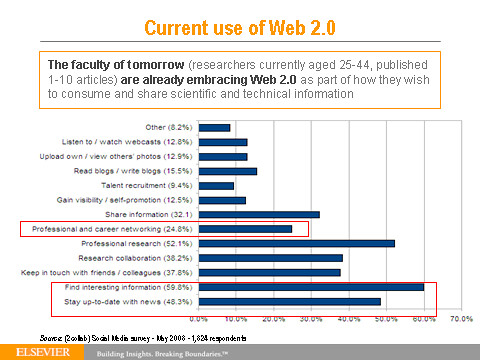
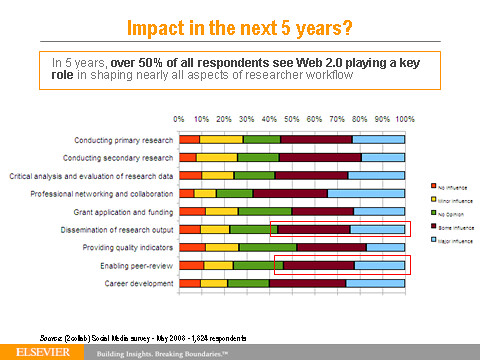
After showing how early career researchers are currently using social media, I delve into 2collab as an example of one possible tool journal editors can use to engage with this demographic. One of my primary suggestions is suggesting that authors use 2collab to share their articles alongside supplementary content related to their articles. For example, one can use 2collab to share images from a paper, related presentations, and the article itself all in one place. One of the reasons I was motivated to write this post was to practice what I preach. Some screenshots of Flickr, Slideshare, my blog, and 2collab, related to this post are still to be included in the appendix of the presentation as an example.
Last, I open things up for discussion. To do this I prompt editor’s to think about how they can apply available Web 2.0 tools to the tasks of editing, such as promotion of articles. For those of you familiar with my Master’s paper, you will recognize this methodology as 1 part of my Academic 2.0 theory.
When you get a chance, please take a look at the presentation and let me know if you have any suggestions about how journal editor’s or authors can use social media.
Also, please send any examples you know of editors using social media such as blogs or Flickr to interact with authors, editorial boards, or readers. Thanks.
links for 2007-11-04
-
Welcome Workperch into the World! « Workperch!
Launching
tomorrowtonight at Midnight! “Workperch was built over a single weekend… We were born as a result of Startup Weekend Chapel Hill. Workperch aims to connect entrepreneurs and others in need of short-term office space with office space in their area.”
links for 2007-10-26
-
claimID weblog – Manage your online identity. » Archive » Library Journal on ClaimIDFred highlights the claimID article on the claimID blog.
-
“The report is based on a survey (by Harris Interactive on behalf of OCLC) of the general public from six countries—Canada, France, Germany, Japan, the United Kingdom and the United States—and of library directors from the U.S.” 280p.
-
Chapel Hill Startup Weekend — November 2-4“Startup Weekend is an idea, an experiment, a chance gather the tech community and create a company over one jam packed weekend.”
-
Fred’s announcement about the article on his personal blog.
links for 2007-08-09
-
Corey Reece » Blog Archive » Walled gardens no more. (A unified social network and the makings of a plan)
I met Corey at BarCamp and we got to discuss this idea. I look forward to seeing where he takes it next.
-
RDU Start Up Weekend
There was a brief preliminary meeting at BarCampRDU.
-
An older report. Just saving it for later: “A December 2006 survey has found that 28% of internet users have tagged or categorized content online such as photos, news stories or blog posts.”
-
Thingology (LibraryThing’s ideas blog): Tagmash: Book tagging grows up
This is a major move forward in tagging: “In getting past words or short phrases, tagmash closes some of the gap between tagging and professional subject classifications.”
-
Tagmashes from LibraryThing. Many-to-Many:
Weinberger’s take: “With tagmashes, the info that this tag is related to that one is gleaned from the fact that a human said that they were related.”
-
Tame The Web: Libraries and Technology: Abstract: Modeling the role of blogging in librarianship
The abstract for Michael’s dissertation. I really look forward to reading it.