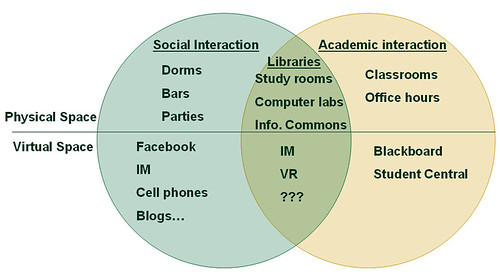
I developed the above model for a paper I wrote for INLS 342: Academic Libraries Seminar. This is very much a work in progress. I hope to explore this area further for my Master’s Paper.
The paper was titled Defining Academic Library 2.0. However, in it I argue for a narrower definition of Library 2.0 than the broader definitions proposed by Michael Casey and Michael Stephens. My narrower definition is as follows:
The application and adaptation of the Web 2.0 model to the library environment (both virtual and physical).
Consequently, the above model proposes a way to look at the libraries role in students lives in a Web 2.0 world.
Below is a slightly edited excerpt from my paper:
One approach to adapting Web 2.0 technologies to academic library services is to examine how these technologies already fit into student life and then determine the library’s role in this picture. Figure 2 introduces one conceptual framework that applies this method. This model analyzes the libraries’ position as a physical place in student life and then draws parallels with libraries’ possible position as a virtual place. The model is based on the concept that most of student life is divided between the social and the academic and that physical libraries have traditionally provided a unique location that mixes the two. A more precise model would show a spectrum between social and academic places with libraries falling near the middle. At one end is the strictly academic formal classroom. Here the professor is an authority to the student. At the opposite end is a party, a purely social occasion. Libraries have traditionally provided a place where students could collaborate on school work without the pressure of being watched by an authority figure, thus allowing them to socialize while they work. Of course, this space also provided students with whatever research materials and reference assistance they might need. Towards this end, librarians have traditionally tried to maintain strict patron confidentiality so as to keep the library a safe haven from authority. Furthermore, many academic libraries now provide popular materials collections to provide residential students with materials for pleasure reading, thus further blending the line between social and academic space. Recent trends in academic libraries have moved closer to blending this line by adding coffee shops, WiFi access and Information Commons. If one accepts that the physical library provides students with this blended environment, then one might ask, “How might the library provide a similar virtual space?†To find an answer to this question, this conceptual model creates a parallel spectrum describing a student’s virtual life. At the academic end of the spectrum, lies course management software such as Blackboard. Similar to the classroom, this space is controlled by the professor and has the same authority structure. On the social end of the spectrum, is Facebook. Students traditionally think of this as a safe social place devoid of authority figures. This is demonstrated by the fact that students have recently been punished for information they post to Facebook. To examine this phenomenon, one need only Google “facebook†and “disciplineâ€. Stutzman’s research demonstrates this feeling of safety (2005; 2006). Given this spectrum, what virtual place might the library provide for students? One possibility would be virtual group study rooms. Such a place might provide the tools to enable students to collaborate remotely and asynchronously on course projects. This space might also provide resources and links to live reference help to assist students in their work. This place would be different from Blackboard because professors would not be able to review students’ discussions. This proposal is just one possibility; hopefully this conceptual framework suggests others. This conceptual framework only suggests one way to examine how academic libraries might apply Web 2.0 concepts to their mission. Another way is to examine what data academic libraries have available.
To learn more about my vision for Academic Library 2.0, you can view a copy of the accompanying presentation here (.pdf)
library 2.0web 2.0 academiclibrary20