Engaging a New Generation of Authors, Editors, and Reviewers – Presentation for Boston Editors’ Conference

This is the second presentation I will be giving to editors since having taken on the role of Product Manager for 2collab. The presentation breaks down into three sections.

First, I present the findings from the Social Media web survey conducted in May 2008 by my predecessors at 2collab. Conducted using Survey Monkey, 40,000 randomly sampled registered users of ScienceDirect were contacted with a 4.6% response rate yeilding 1,824 responses.

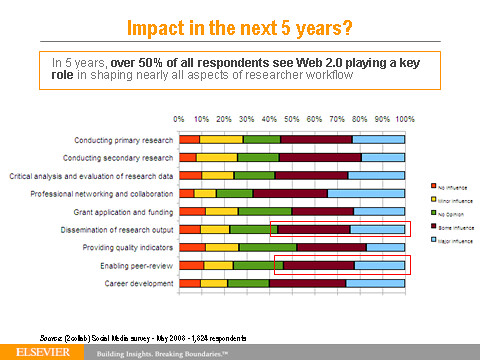
This survey demonstrated that early career researchers (25-44 yrs/old, 1-10 articles), are not only using social media heavily, but they are using it more for work than for play. When comparing how this demographic is currently using social media for work, with how the entirety of respondents expect social media to be used in the next two years, one can see gaps in what tools are available and what are desired. A lot of what I am working on as a Collaboration Tools Product Manager will try to fill these and other gaps in a researcher’s workflow.
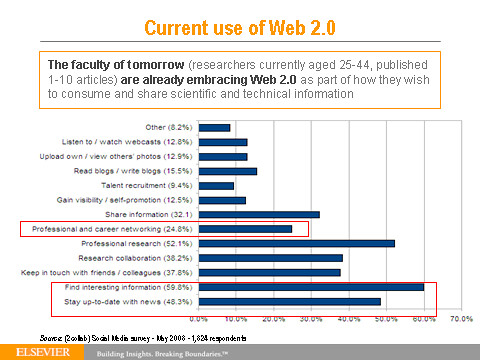
2collabsocialmediasurveycurrentusage

2collabsocialmediasurveyexpectedusage

After showing how early career researchers are currently using social media, I delve into 2collab as an example of one possible tool journal editors can use to engage with this demographic. One of my primary suggestions is suggesting that authors use 2collab to share their articles alongside supplementary content related to their articles. For example, one can use 2collab to share images from a paper, related presentations, and the article itself all in one place. One of the reasons I was motivated to write this post was to practice what I preach. Some screenshots of Flickr, Slideshare, my blog, and 2collab, related to this post are still to be included in the appendix of the presentation as an example.

Last, I open things up for discussion. To do this I prompt editor’s to think about how they can apply available Web 2.0 tools to the tasks of editing, such as promotion of articles. For those of you familiar with my Master’s paper, you will recognize this methodology as 1 part of my Academic 2.0 theory.

When you get a chance, please take a look at the presentation and let me know if you have any suggestions about how journal editor’s or authors can use social media.

Also, please send any examples you know of editors using social media such as blogs or Flickr to interact with authors, editorial boards, or readers. Thanks.

SciTopics launched!!! Congratulations to the SciTopics team!

SciTopics Homepage

SciTopics is a free, wiki-like service for the scientific community, where scientific experts summarize specific scientific topics, and where links to the latest, most relevant journal literature and web sources are presented on one page.”  Originally born as Scirus Topic Pages Beta, Scitopics has come of age.  Currently there are 650 pages and many more are currently being worked on.  For more details, check it out for yourself or read more about it in this Information Today article.

links for 2008-09-25

  • via ALDirect – It frustrates me when I can’t leave comments. See post: on Democracy, Trust, and Libraries. I also discuss this issue in my Master’s Paper.
  • “There’s something important in there for the science community, creating an online identity is of growing importance, whether you do it through your lab’s web page, your set of tagged articles on Digg, your blog about your research or personal interests or your photos on Flickr. When people are interested in asking you to give a talk, hiring you, joining your lab, or collaborating with you, they’re going to look you up via Google, and as the Times article points out, there’s a danger in not participating, and thus not controlling your online image”
  • SmallWorlds project at U. of Leicester: “This project will facilitate the construction of online professional networks using freely available Web 2.0 tools to support the development of early career stage laboratory scientists in the Life and Physical Sciences. We will do this by guiding and encouraging development of clustered small world networks.”
  • Press release from NIH
    (tags: nih pressrelease)
  • “Amid a national debate over the influence of industry money on medical research and practice, two pharmaceutical giants say they will begin publicly reporting payments they make to outside doctors.”
  • “Dr. Zerhouni was chosen after President Bush announced strict limits on federal financing of stem-cell research, and the White House made clear that Dr. Zerhouni was expected to support this policy. But in 2004 and 2005, Dr. Zerhouni told Congress that the president’s policy was hindering scientific progress.”
    (tags: nih)

links for 2008-09-23